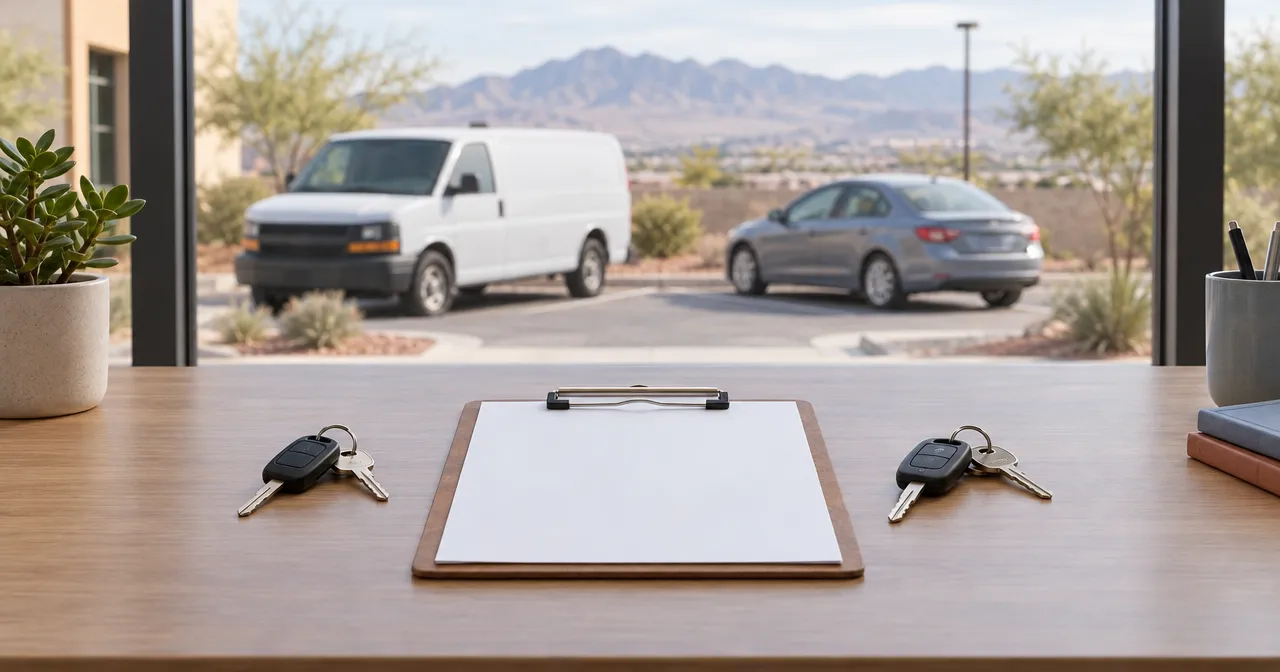
Your Las Vegas business has one service van, but it is not the only vehicle used for work. An office manager drives her own sedan to the bank. A supervisor picks up supplies in a rental car while the van is in the shop. A new hire occasionally visits job sites in his pickup. If one of those drivers causes a crash, which insurance addresses an injury claim against the business?
The answer is not simply “the employee has car insurance” or “we already have a business owners policy.” The vehicle’s owner, the reason for the trip, the driver’s personal coverage, the business’s policies, and the actual claim all matter. This is why hired and non-owned auto insurance deserves a place in a small-business coverage review, even if the company has no fleet.
Here is a practical way for owners in Las Vegas and Henderson—and businesses operating in Reno or elsewhere in Nevada—to examine the gap without assuming every business trip requires the same policy.
First, identify whose vehicle is being used
Three categories help organize the conversation:
- Business-owned vehicles: A van, truck, or car owned by the company normally belongs on an appropriate commercial auto policy. Ask which vehicles, drivers, uses, liability limits, and physical-damage options the policy actually includes.
- Hired vehicles: A car, van, or truck the business rents, hires, or borrows for its operations may fall within hired-auto coverage, depending on the policy definition and the rental arrangement. A vehicle rented in an employee’s personal name can raise additional questions; disclose who signs and pays for the rental.
- Non-owned vehicles: Cars the business does not own, lease, or hire—often employees’ personal vehicles—used for company work may create non-owned auto liability exposure.
The Insurance Information Institute’s small-business vehicle guide explains that a business owners policy (BOP) does not provide vehicle coverage and that the scope of a business auto policy depends on the covered-vehicle options selected. Do not infer the coverage from the word “business” on the declarations page. Find the actual auto policy or endorsement, its limit, and the vehicles or uses it applies to.
A trip to pick up lunch for yourself is different from a scheduled delivery for customers. A drive from home to a regular workplace is different from a work errand during the day. Tell the agent what staff really do, including occasional trips, rather than relying on an informal label like “mostly office work.” The insurer and policy terms determine how those uses are treated.
What hired and non-owned auto liability is meant to do
If someone alleges that your business is legally responsible for injury or property damage arising from use of a hired or non-owned vehicle, this coverage may help with the business’s liability and defense, subject to the policy’s terms. It is not the same as insuring every car an employee drives. Travelers describes hired and non-owned auto coverage as liability protection for covered accidents involving rented vehicles and vehicles the business does not own.
Consider a Henderson design firm whose employee uses her own car to deliver samples to a client in Las Vegas. She is involved in a collision, and the other driver alleges both the employee and the firm are responsible. The employee’s personal auto insurer may have a role; the firm’s non-owned auto liability may also have a role if the claim and circumstances meet its terms. Neither policy should be described as a guaranteed first or last payer without reviewing the forms and the facts.
Now consider a contractor renting a pickup in the business’s name to move tools to a Reno job. If a covered crash injures someone else, hired-auto liability may protect the business against qualifying third-party claims. But damage to the rented pickup itself is a separate physical-damage question. Ask about a hired-auto physical-damage option, the rental company’s terms, deductibles, and any exclusions before declining a rental protection product. Liability coverage alone is not a promise to repair the rental.
In many arrangements, the employee’s personal auto liability is expected to respond first when the employee uses a personal car, while the company’s non-owned auto liability responds in relation to the business’s exposure under its own terms. The Hartford’s discussion of insuring employees describes non-owned auto as typically excess over an employee’s personal coverage. Order of payment and defense can vary, so confirm it for your policy rather than treating this as a universal rule.
What it does not replace
The employee’s personal auto policy. Non-owned auto liability does not automatically insure the employee as a driver, replace the employee’s own insurance, or fix a personal policy’s restriction on business, delivery, or for-hire driving. Ask staff to tell their personal auto insurers about actual work use and verify any coverage requirements the business sets. Do not promise employees that the company policy will pay for their vehicle repairs.
Commercial auto for vehicles you own. If the company buys a van, adds a second truck, or takes title to a car previously owned by an employee, update the commercial auto coverage promptly. A hired/non-owned endorsement is not a substitute for scheduling or otherwise correctly covering company-owned vehicles. Ask about drivers, vehicle use, garaging location, collision and comprehensive coverage, and deductibles. The NAIC’s small-business insurance overview identifies commercial auto as a distinct coverage and notes that policies may have provisions for rented and non-owned vehicles.
General liability and property insurance. A BOP may address a customer slipping at your leased shop and certain property losses, but it is not the auto liability solution for an on-the-road collision. A business-income feature is typically tied to qualifying covered property damage and its own conditions; it should not be assumed to reimburse every disruption after a vehicle crash. Review the trigger if a damaged van would halt operations.
Workers’ compensation. An employee hurt on a work-related trip raises an employee-injury question, separate from a third party’s auto liability claim. In Nevada, employers generally must secure workers’ compensation coverage when they have one or more employees, subject to statutory exceptions and classification rules; the Nevada Division of Industrial Relations’ 2026 employer guide explains the requirement. If a crash involves employees or work across state lines, report the circumstances to the relevant insurers and ask a qualified adviser about jurisdiction and policy applicability. Do not assume the hired/non-owned endorsement pays an injured employee’s medical bills.
Test your liability limits with an actual scenario
A liability limit is the maximum an insurer will pay for a covered claim or category of claims as the policy specifies; it is not an estimate of the worst accident your business could face. Check whether a stated limit applies per accident and whether defense costs are inside or outside it. Confirm any contractual minimums required by a landlord, client, or prime contractor, but remember a contract’s minimum is not a personalized assessment of your exposure.
For illustration, suppose an employee’s personal auto policy has $100,000 of applicable bodily-injury liability coverage for an accident. A serious claim is valued at $400,000, and the business is alleged to share responsibility because the employee was making a delivery. There may be a $300,000 amount beyond that illustrative personal-policy limit—but that does not mean the business policy automatically pays $300,000. The employee’s policy wording, available limits for other claimants, allocation of fault, the business’s legal liability, any non-owned auto endorsement, exclusions, and defense arrangements all affect the outcome. The example is a prompt to compare limits, not a claim prediction.
Ask your agent to place the employee’s required personal auto limits next to your business auto limit and any commercial umbrella or excess liability coverage. An umbrella may require specific underlying limits and may cover some—but not every—underlying exposure. A personal umbrella purchased for an owner’s home and family vehicles is not a substitute for the company’s commercial liability program. If your business has drivers using their own cars weekly, low personal limits can complicate the overall risk even when the company has a higher limit.
Also distinguish liability limits from property deductibles. An auto liability claim may have a different deductible or retention arrangement from the deductible for repairing a company vehicle or a hired vehicle; some policy forms have no standard liability deductible. Read the declarations and endorsements. If a rented vehicle is damaged, ask what deductible or contractual obligation could leave your business paying out of pocket.
The activities most likely to change your answer
A good review starts with a description of work, not a product name. These are especially useful checkpoints:
- New employee or new role. A hire who was expected to work at the office may begin visiting clients or delivering materials. Ask whether regular drivers are eligible, how driving records are reviewed, and whether the insurer needs updated driver information.
- Delivery or transport for a fee. Food delivery, transporting passengers, moving client property, and using an app-based platform can be treated differently from an occasional office errand. Describe the exact activity and platform rather than assuming “business use” covers all of it.
- A rental or loaner. Record who rents it, who is authorized to drive it, its purpose, dates, and whether it is a replacement for an insured company vehicle. Check liability and physical damage separately.
- A new company vehicle. Give the insurer the vehicle details and intended use before it goes into service; ask when coverage begins and whether it must be listed. If vehicles travel regularly between Nevada, Utah, and Arizona, disclose that pattern and each vehicle’s usual garaging location.
- A client contract or lease. A certificate of insurance shows information about a policy; it does not, by itself, add coverage or change policy wording. If a contract calls for additional insured status, specific auto liability limits, or other terms, ask for a review before signing. Do not promise a requirement your policy cannot meet.
- Renewal. Compare the existing and proposed declarations, endorsements, vehicles, driver rules, limits, and deductibles. An unchanged premium is not evidence that the business’s driving exposure is unchanged.
For a Las Vegas business with two field technicians, one company van, and occasional use of employee cars, the review might reveal three different decisions: list the van on the commercial auto policy, verify the non-owned auto liability treatment of the technicians’ cars, and consider hired-auto liability and physical-damage options for temporary rentals. The best combination depends on use, available terms, and the premium and out-of-pocket risk the business can carry.
Prepare before a claim, and know what to do afterward
Keep a simple record of who is authorized to drive for work, which vehicles are company-owned, what personal-car use is permitted, and who approves rentals. A mileage reimbursement program or a rule requiring a minimum personal auto limit may help clarify expectations, but neither creates insurance coverage. Request confirmation of coverage through the applicable insurers rather than relying only on a driver’s verbal assurance.
After a crash, prioritize safety and emergency help. Gather basic information, preserve photos and records where safe, and notify the relevant personal, commercial auto, rental, and workers’ compensation insurers as appropriate. Tell them why the trip was being made and who owned or rented the vehicle; avoid guessing at fault or promising that a specific policy will pay. Save claim numbers and ask who will coordinate next steps. Jonathan Penn Insurance Agency’s team can help clients understand their policies and navigate coverage questions during a claim, while the insurers decide coverage under their contracts.
Hired and non-owned auto protection is most useful when it matches the trips your people actually make. Jonathan Penn Insurance Agency helps small and midsize businesses in the Las Vegas metro area, Henderson, Reno, and the rest of Nevada, Utah, and Arizona review commercial auto alongside general liability, BOP, and workers’ compensation coverage. Bring the vehicle list, driving practices, current declarations, and contract requirements to a conversation about protection that fits your operation and budget.